

Queens’ College members were part of the team that recently explored newly exposed seafloor in the Antarctic earlier this year.
8th April 2025
Dr Svetlana Radionovskaya (Queens’ JRF) and Dr Laura Cimoli (Queens’ PDRA) recently participated in a 35-day long oceanographic expedition to Antarctica in Jan-Feb 2025, onboard Schmidt Ocean Institute vessel R/V Falkor (too). Laura’s work on the cruise is also part of the grant she led in collaboration with Professor Kate Hendry (Queens’ Bye-Fellow).
During their expedition, whilst they were sampling the Ronne Entrance area (in the Bellingshausen Sea, west Antarctica), a significant event occurred when iceberg A-84, measuring approximately 510 square kilometres, calved from the George VI Ice Shelf. This separation unveiled a previously inaccessible seafloor. Seizing this rare opportunity, scientists onboard conducted an eight-day exploration of the newly exposed area.
“We were thrilled by the opportunity to explore the newly exposed seafloor,” said Dr Radionovskaya. “The research will provide key insights into ice sheet dynamics, oceanography and sub-ice shelf ecosystems. At a time when the West Antarctic Ice Sheet is melting at an alarming rate, understanding these dynamics and their impacts is crucial.”
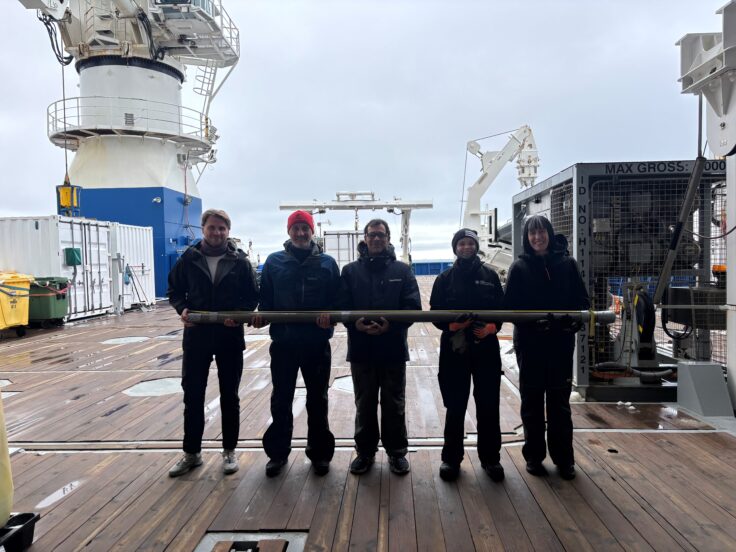
Long gravity core collected during the expedition. From left to right: Dr Aleksandr Montelli, Dr Cristian Rodrigo, Dr Eugenio Veloso, Dr Svetlana Radionovskaya, Rachel Timbs. Photo credit: RV Falkor (too)
Dr Radionovskaya used different instruments to collect sediments from the seabed, as well as rocks and discrete seawater samples. Her analyses will help reconstruct the ocean circulation of the past hundreds to thousands of years.
They discovered thriving ecosystems at depths up to 1,300 meters, including large corals and sponges hosting various marine life such as icefish, giant sea spiders, and octopuses. Their activities also included the collection of geophysical, chemical and biological samples.
The presence and size of these organisms suggest that these communities have been established for decades, if not centuries, offering valuable insights into life beneath Antarctic ice shelves.
“The fact that we found long-living species suggests that the lateral transport, which mostly consists of glacial meltwater from the ice shelf, could be the source of the nutrients to sustain the life we found,” said Dr Cimoli.
Dr Cimoli deployed autonomous vehicles named underwater gliders, which sample seawater properties such as temperature and salinity for weeks or months on end, returning information about the present-day ocean circulation.
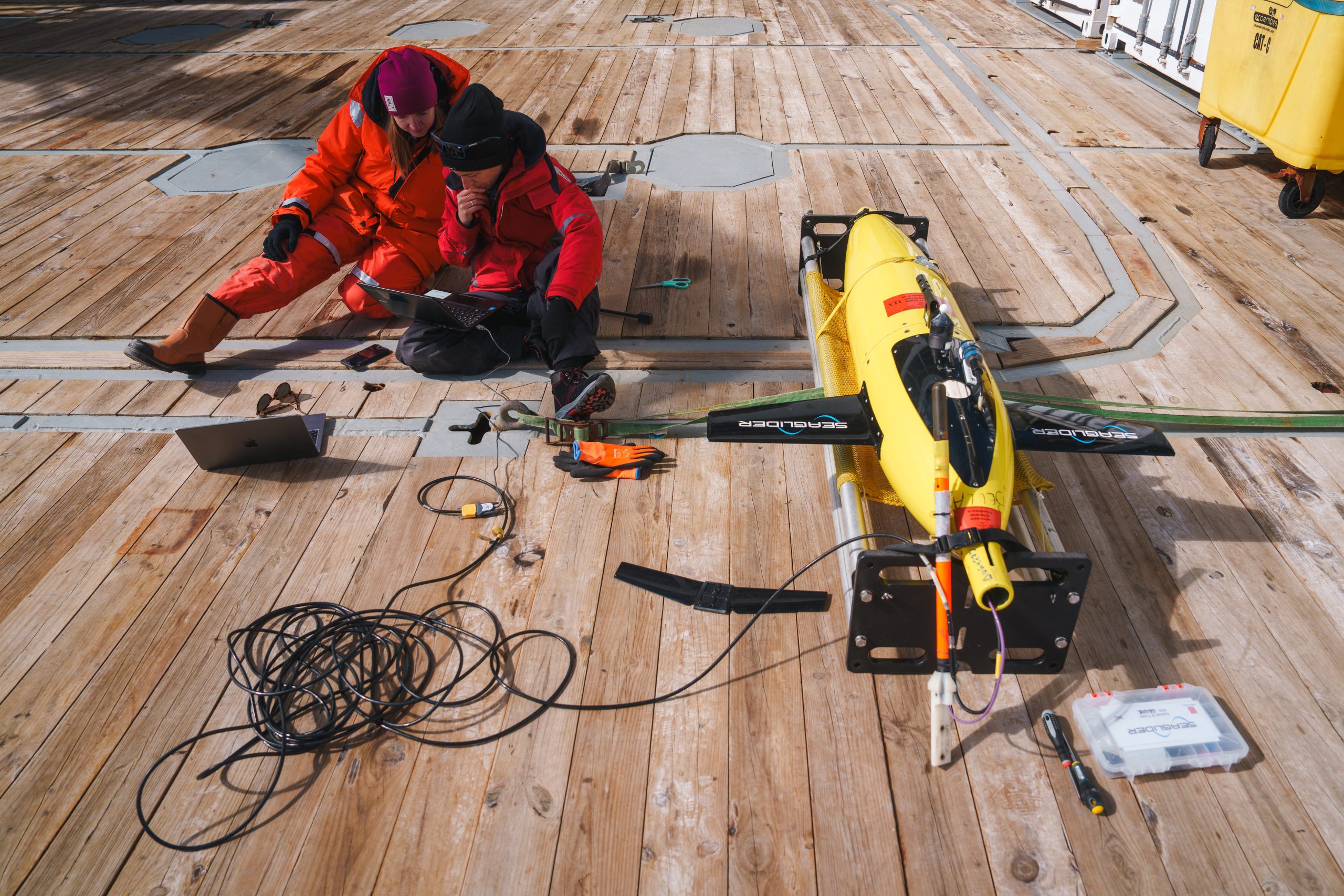
Dr Cimoli (right) and Dr Meyer (UEA, left) prepare an underwater glider for deployment. Photo Credit: Alex Ingle/Schmidt Ocean Institute.
Article adapted from:
https://schmidtocean.org/thriving-antarctic-ecosystems-found-in-wake-of-recently-detached-iceberg/
https://www.bas.ac.uk/media-post/thriving-ecosystem-discovered-following-iceberg-calving/
https://www.cam.ac.uk/research/news/thriving-antarctic-ecosystems-found-following-iceberg-calving

Before we launch into an exciting new academic year, here are a few things that happened over the summer that you might have missed.
28th August 2026

We are delighted to share that Professor Marie Edmonds, FRS, has been appointed as the next Head of the School of the Physical Sciences.
25th August 2026

The New Whittle Laboratory at the University of Cambridge was officially opened by His Majesty King Charles III on 20 July 2026, during the Frank Whittle Summit. Dr Christopher Clark, Fellow of Queens’ College and Lecturer in the Whittle Laboratory, was among the faculty who welcomed His Majesty during the visit.
23rd July 2026

On Friday the 7th of July, Queens’ College welcomed filmmaker Mehmet Sarı for the Empowering Romeyka Voices event, a screening of two documentaries (including Sarı’s newest, The Cursed Forest) and a discussion of his work and background.
8th July 2026


Site Search